OConnor, Patrick F. beloved husband of Patricia (nee Scarano), fond brother of John P. (Eileen), William and Mary Ellen Kunce and the late James G., brother-in-law of Maureen OConnor, loving uncle of many nieces and nephews. Services and interment private. Conducted by: Lawrence Funeral Home, 773-736-2300.
Chicago Sun-Times, July 3, 2005
Note: Patrick was a Chicago Police Officer
Interior of STA Church
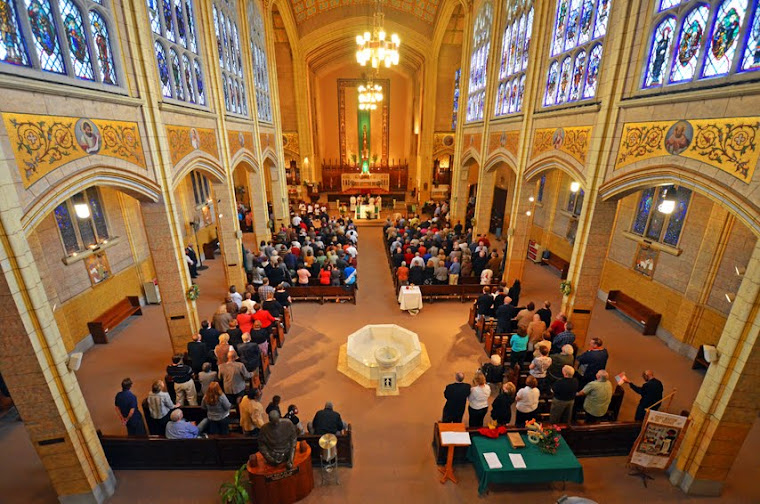
All Class Reunion Day, September 30, 2012. Photo courtesy: Dan Carr (Class of 1960)
Wednesday, September 29, 2010


Saturday, September 25, 2010
In Memoriam - James J. Enright
When Dennis Czechanski tried to find Jim Enright, he reached James' wife, Anne. Since Jim cannot be with us, she wanted to share a bit of his memory with us. The following is from her email.
"After graduating St Mel H.S., Jim went on to become an electrician and was the supervising electrician on many commercial projects in downtown Chicago and the Metro area. He eventually started his own electrical contracting company and ran a successful business working with developers and various business owners.
Jim was also a motorcycle enthusiast and avid skier. He was active in the River Shannon Ski Club as the vice president and oversaw many outings and trips. He enjoyed traveling, fishing, ethnic cuisines and loved children and was the "Secret Santa" to many in need.
His kindness, generosity, loving spirit and zest for life will always be remembered by all those he left behind.
His kindness, generosity, loving spirit and zest for life will always be remembered by all those he left behind.
He slipped away in peace after a long battle with pancreatic cancer.
Hope this was not too long. I made a point of the electrical career because he was so proud of it. His employees and business associates were like family. He would never have missed this reunion - and I'm sure he'll be there in spirit. Please keep me posted how it all goes.
Thank you for your kind words - I was thrown backwards emotionally remembering things he did and well it was difficult."
Hope this was not too long. I made a point of the electrical career because he was so proud of it. His employees and business associates were like family. He would never have missed this reunion - and I'm sure he'll be there in spirit. Please keep me posted how it all goes.
Thank you for your kind words - I was thrown backwards emotionally remembering things he did and well it was difficult."
Anne Enright
JAMES J. ENRIGHT 1946 - 2007
James J. Enright, age 60, beloved husband of Anne, nee Konopka; survived by brother, Donald (Marjorie) O'Shea; brothers-in-law Anthony (June) and Richard Konopka; nieces, Kathy O'Shea and Karen (Pat) McGinley; nephew Michael (Sabine) O'Shea; God daughters, Michelle (William Jr.) DeRosa and Juliana Ejsmont; his devoted friends, Mark Wettig and Morgan Dubiel; many cousins and friends.
Memorial visitation Monday, Aug. 13, from 5 p.m. until 9 p.m. at Olson Burke/Sullivan Funeral & Cremation Center, 6471 N. Northwest Hwy. (1 blk N. of Devon), Chicago.
Family and friends will meet Tuesday morning at St. Alphonsus Church, 411 N. Wheeling Rd., Prospect Heights for a Memorial Mass at 10 a.m. Interment private.
Info Olson Burke/Sullivan Funeral & Cremation Center, 773-774-3333.
Sign Guestbook at chicagotribune.com/obituaries
Tuesday, August 10, 2010
Six Degrees of Separation
Peggy Dernbach Kuzminski has a contemporary connection with Mrs. Watts, our 7th grade teacher. She shares the following story:
In 1999, my daughter Kathleen volunteered to go on a trip with other college students to the Lourdes Shrine in France. Queen of All Saints Church was sponsoring the trip and Fr. Wayne, assistant Pastor, was coordinating it.
The volunteers would be assisting with meeting handicapped individuals at the train, helping at the shrine, etc. They spent one week in Lourdes and then Fr. Wayne, adult chaperons and college kids went on a second week’s trip to Ireland.
Fr. Wayne had a meeting of the parents prior to the trip to explain the trip, cost, etc., and that is when I met him. At this point I only knew him as Fr. Wayne. At the meeting he introduced himself as Father Wayne Watts. During the talk he referred to his mother who had been a Catholic school teach – the light went on in my head!
After the meeting I went up and spoke to him and sure enough it was Mrs. Watts’s son. He is really a great priest and does so much good.
Kathleen loved the experience of working at Lourdes and always kept in touch with Fr. Watts. When she and Lowell got engaged she asked him to perform the wedding ceremony and mass. Father Wayne Watts is now Pastor of St. John Berchman’s located at 2511 Logan Boulevard in Chicago.
It truly is a small world.
Peggy
P.S.: On March 27, 2011, Peggy shared an update about her family's connection to Fr. Wayne Watts:
My granddaughter Madeline Grace is going to be baptized by Fr. Watts next Sunday. It truly is a small world. Kathleen, Lowell & Madeline are coming in and the baby will be baptized in Chicago.
In 1999, my daughter Kathleen volunteered to go on a trip with other college students to the Lourdes Shrine in France. Queen of All Saints Church was sponsoring the trip and Fr. Wayne, assistant Pastor, was coordinating it.
The volunteers would be assisting with meeting handicapped individuals at the train, helping at the shrine, etc. They spent one week in Lourdes and then Fr. Wayne, adult chaperons and college kids went on a second week’s trip to Ireland.
Fr. Wayne had a meeting of the parents prior to the trip to explain the trip, cost, etc., and that is when I met him. At this point I only knew him as Fr. Wayne. At the meeting he introduced himself as Father Wayne Watts. During the talk he referred to his mother who had been a Catholic school teach – the light went on in my head!
After the meeting I went up and spoke to him and sure enough it was Mrs. Watts’s son. He is really a great priest and does so much good.
Kathleen loved the experience of working at Lourdes and always kept in touch with Fr. Watts. When she and Lowell got engaged she asked him to perform the wedding ceremony and mass. Father Wayne Watts is now Pastor of St. John Berchman’s located at 2511 Logan Boulevard in Chicago.
It truly is a small world.
Peggy
P.S.: On March 27, 2011, Peggy shared an update about her family's connection to Fr. Wayne Watts:
My granddaughter Madeline Grace is going to be baptized by Fr. Watts next Sunday. It truly is a small world. Kathleen, Lowell & Madeline are coming in and the baby will be baptized in Chicago.
Monday, August 9, 2010
Austin Neighborhood History
Austin
Community Area 25, 7 miles W of the Loop. Austin, on Chicago's western border, evolved from a country village to a dense urban neighborhood between 1870 and 1920. For the next 50 years this was a large community of solidly middle class residents, but since 1970 it has experienced a profound social and economic transformation. Austin had three important early influences: its founder, Henry Austin (also instrumental in Oak Park's development); transit lines, notably the Chicago & Northwestern Railroad and the Lake Street Elevated; and a rivalry with neighboring Oak Park.
Austin was created in 1865, when developer Henry Austin purchased 470 acres for a temperance settlement named “Austinville” (Chicago Avenue to Madison Street, and Laramie to Austin Boulevard). Austin's intentions for the settlement were clear: home ownership, public amenities such as tree-lined parkways, and gracious living—though Austin himself lived in Oak Park. The village had nearly 1,000 residents by 1874, owing largely to steadily improving suburban railroad service. With over 4,000 residents by the 1890s, Austin was the largest settlement in Cicero township. In 1899, Austin was voted out of the township and into Chicago by residents of other parts of the township. Austin's residents sought to maintain an independent identity after annexation. An ambitious illustration was the 1929 construction of Austin Town Hall, modeled on Philadelphia's Independence Hall.
By 1920 Austin was one of Chicago's best-served commuter areas, with street railways to downtown Chicago every half mile, the busiest being the Madison Street “Green Hornet.” The area was also served by the Lake Street “L” rapid transit. Commerce in Austin followed transit lines, with significant business development along Madison Street, Chicago Avenue, and Lake Street. Despite its commercial range and volume, Austin lacked the intense retail centrality of West Garfield Park (on Madison, from Pulaski to Cicero) or of Oak Park (at Lake and Harlem). In 1950 Austin was a predominantly residential community, with major industrial corridors to the east, north, and south.
Austin early attracted upwardly mobile Germans and Scandinavians, followed by Irish and Italian families. These groups built the community's mid-twentieth-century landmarks: a half-dozen sizable Roman Catholic parishes, which annually educated thousands of children and provided the social base for much of the community. By the 1930s Greek migrants had arrived in south Austin, building their own landmark, the Byzantine-style Assumption church. Austin had 130,000 residents by 1930.
Dense housing development almost completely supplanted the village landscape of large frame homes in the early twentieth century: north Austin sprouted brick two-flats, small frame houses, and the ubiquitous brick story-and-a-half bungalow; in south Austin, rowhouses, sizable corner apartment blocks, and a multitude of brick three-flats and courtyard apartment buildings flourished. Despite the massive scale change, the nineteenth-century village residential core is still visible in the Midway Park area north of Central and Lake, a designated National Register historic district (1985). This neighborhood boasts stately neoclassical and Queen Anne–style homes, many designed by architect Frederick Schock, as well as several structures by Frank Lloyd Wright and his students.
Austin's crown jewel was Columbus Park (1920). Designed in a prairie mode by renowned landscape artist Jens Jensen, the park featured a lagoon, a golf course, athletic fields and a swimming pool, as well as winding paths and an imposing refectory overlooking the lagoon. Assaulted by expressway construction in the 1960s, the park was extensively restored in 1992.
Austin's demographic profile shifted dramatically beginning in the late 1960s. By 1980 Austin's population was predominantly African American, more than 96 percent in south Austin. Like other west-side communities, Austin experienced housing disinvestment, vacancy, and demolition, as well as loss of jobs and of commerce as its white population moved to the suburbs and to Chicago's Northwest Side. Neighborhood groups like the Organization for a Better Austin have worked to stabilize the community, as have nonprofit housing developers aided by South Shore Bank.
Sunday, August 8, 2010
East side of Latrobe between Fulton and Washington
A 2010 look at the east side of Latrobe between Fulton Avenue and Washington Boulevard. Did any of you live on Latrobe?
Source: Dan Carr's Serendipitize
Wednesday, August 4, 2010
Aquinasville
360-degree images of the St. Thomas Aquinas Community
Our classmate, Dan Carr, has put up a blog which creatively uses Google images to provide a current look at the community immediately surrounding St. Tommy's. He has "captured" views of the Church, school, rectory and convent as well as street scenes viewed from
- Laramie and Washington,
- Le Claire and West End,
- West End and Leamington
- Washington and Le Claire
Because the images are 360 degrees, it takes a few seconds for them to load -- so please be patient. Once the pictures have loaded, you will be able to navigate up, down, AND all around to get a full-circle view from the perspective point. There are multiple images on each post and several posts, so be sure to click on "older posts" at the bottom right-hand corner of each page to view them all. The images provide a wonderful look at the neighborhood today.
Also, Dan has created a four-minute "drive-around-St.-Tommy's-in-the-rain" video. Be sure to check it out too! Dan has offered to take other videos, so take a look at his Blog and MAKE A SUGGESTION.
To virtually visit the campus of our alma mater click here: Aquinasville
You can return to the St. Thomas Aquinas 50th Reunion site by clicking on 50th Reunion at the bottom of each of the Aquinasville blog postings. See you back here later.
Sunday, August 1, 2010
A Drive Up Lake Street
One of our classmates recently became interested in videography -- much to our benefit! In this first posted video, our videographer takes a ride under the "el" tracks driving west from Kedzie Avenue to Laramie Avenue. It provides a great up-close view of Lake Street.
For those of you who don't live in the Chicago area (or even if you do), wouldn't you love to see what it looks like around St. Tommy's, the old west side, and even Chicago in general? If we are lucky, we might get a few more videos.
Let's hear some "comments" so we can encourage our classmate to continue these wonderful efforts. All you have to do is click on the "comment" hyperlink at the end of this post, type in your comment in the box that appears and then click "post comment." Let's cheer our budding "Cecil B. DeMille" on!
For those of you who don't live in the Chicago area (or even if you do), wouldn't you love to see what it looks like around St. Tommy's, the old west side, and even Chicago in general? If we are lucky, we might get a few more videos.
Let's hear some "comments" so we can encourage our classmate to continue these wonderful efforts. All you have to do is click on the "comment" hyperlink at the end of this post, type in your comment in the box that appears and then click "post comment." Let's cheer our budding "Cecil B. DeMille" on!
Subscribe to:
Posts (Atom)