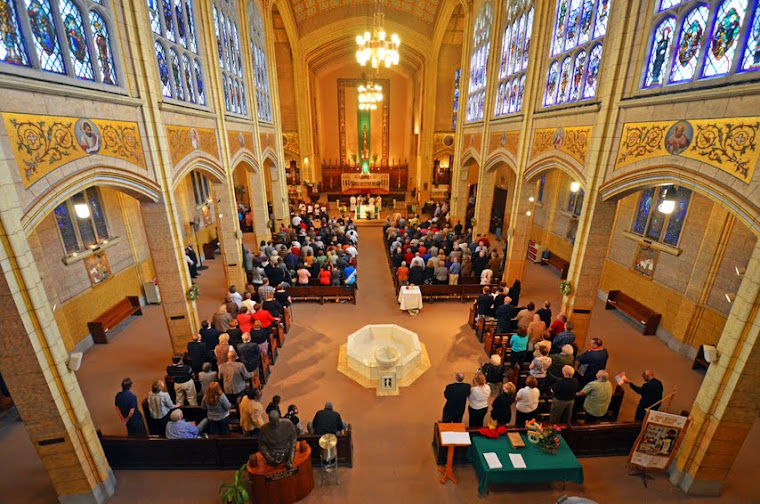
Fr. Thomas Libera, pastor of St. Martin de Porres, invites all St. Thomas Aquinas alums, family and friends to celebrate 25 years of worship and community service at St. Martin de Porres Church November 1 - 3, 2013.
The festivities include a concert, luncheon (Elmcrest Banquet Hall, Elmwood) and Feast Day Unity Mass.
His Eminence Francis Cardinal George will be principal celebrant on Sunday, November 3, 2013 at the Feast of St. Martin de Porres.
If you haven't been to our beautiful church lately, or even if you have, consider joining parishioners, community members, alumni and friends at one of the scheduled activities over the Feast Day weekend activities.
For more information call the rectory at 773-287-0206 or email st.martindeporres@sbcglobal.net
Welcome to the St. Thomas Aquinas Parish website. Alumni of the School and Parish have contributed photos, stories and memories from their days on the Westside. St. Martin de Porres Parish now encompasses the former STA. Enjoy.
Interior of STA Church
All Class Reunion Day, September 30, 2012. Photo courtesy: Dan Carr (Class of 1960)
Showing posts with label St. Martin de Porres. Show all posts
Thursday, October 10, 2013
Monday, August 20, 2012
Joy and Sadness to Christen Parish - 1992
Patrick Reardon (Class of 1963), author of the following article which appeared in the Chicago Tribune in 1992, is planning on joining us at our September 30, 2012 reunion. The newspaper article was written just prior to St. Martin de Porres Church being formally dedicated. Thank you Pat for a beautiful article.
Joy and sadness to christen parish
It is a new church, and it isn't. It is a beginning, but also an end. It is a time of joy, and a time of sorrow.
On Feb. 9, Cardinal Joseph Bernardin will go to the Austin neighborhood on Chicago's Far West Side for the formal dedication of St. Martin de Porres Catholic Church, 5112 W. Washington Blvd.
St. Martin was a 17th Century mulatto physician whose work as a Dominican lay brother among the sick and poor of Peru made him that country's patron saint of social justice.
The new parish, named for him, is made up of some 500 families, nearly all of them African-Americans, who come from throughout the city and even the suburbs to worship together.
The parish was organized in 1988, but it wasn't until last Nov. 3, St. Martin's feast day, that the congregation was able to move into its permanent worship site.
"It's beautiful," says Sandra Backstrom, a Chicago public school teacher. "For me, it's a dream come true."
Much of Backstrom's happiness comes from the fact that St. Martin really isn't a new church. Instead, it's a new parish in an old church building, the same building where she worshiped for more than 15 years as a member of the St. Thomas Aquinas parish.
The St. Thomas Aquinas church building, which had served West Side Catholics for 64 years, was closed three years ago and had been in danger of being torn down. To see it now, reopened and renovated at a cost of nearly $700,000, gives Backstrom a keen delight.
But there are many for whom the joy of next month's formal dedication will be mixed with sadness and regret.
The new St. Martin parish is the result of financial difficulties that led Bernardin to urge the consolidation of three West Side parishes: St. Thomas Aquinas, St. Mel-Holy Ghost and Resurrection.
Following a long meeting process, congregation members decided that they wanted to put up a new church building for their new parish, rather than renovate any of the worship sites of the three old parishes.
But, by that time, the fall of 1990, the archdiocese was in even deeper financial trouble, and Bernardin said a new building was out of the question. Instead, the archdiocese would help pay for the renovation of the St. Thomas Aquinas structure.
"I was disappointed, of course. I shed tears, of course," says Alberta Bowles, a hospital social worker who had wanted a new church building.
And, if not a new building, Bowles would have preferred to have the consolidated congregation meet in the chapel of the old Resurrection parish in the bottom floor of the parish school.
"The Res chapel was viewed as a basement," she says. "But, for those of us who had been worshiping there for years and years, that was church."
Yet, even for the old St. Thomas Aquinas parishioners, there were sorrows that came from the renovation.
As part of the modest redecorating of the building, a bust of St. Martin was put near the front door and a sculpture of the saint was placed in a side alcove.
At the same time, a statue of St. Thomas, one of the most influential theologians in Catholic history, was removed, and the image of St. Thomas that had loomed over the altar in a 50-foot-tall tapestry was painted over.
"I really miss St. Thomas," says Sandra Hilal. "I often sit there and pray that that paint just peels off."
In its first three years, the consolidated parish had celebrated Sunday mass at the St. Mel-Holy Ghost church building, 4301 W. Washington Blvd. It was during that time that Hilal, a resident of the north lakefront neighborhood of Uptown, stopped coming on a regular basis.
Her return coincided with the move to the old St. Thomas building, but she says, "It wasn't the reopening of the church. I'm back because I missed my church family."
She explains: "The people of St. Thomas -- and, I suspect, of St. Mel and Res -- if you're sick, they'll come see you. If your family has problems, they're right there for you. In this parish, if you cry, someone cries with you. And if it's a joyful occasion, they're joyful with you."
Those comments were echoed by others from other parishes. "Wherever my church family is at, that's where I want to be," says Patricia Buford, the president of the choir.
Buford is from Resurrection, as is Avusa Farmer, who despite the bumpy journey that the consolidated congregation has had, says:
"We're one now. You can see people from all three parishes coming together and working together, more so than before. This church is beautiful. Now, hopefully, we're home."
Chicago Tribune, January 22, 1992, page 1.
Author, Patrick T. Reardon, (Class of 1963)
Thursday, July 19, 2012
St. Martin de Porres is Welcoming
This article is from the July, 2012 edition of the Senior Connection and was sent by Bob Blackwell, who used to live just north of St. Thomas Aquinas. He says the author of the article is a fella who is trying to visit all the churches in the Chicagoland area. We are glad the author visited St. Martin de Porres and provided such a positive comment. Note the last paragraph.
We will all be looking forward to experiencing "their joyful music and the way they greet everyone after the Our Father" on Sunday, September 30 when we join the congregation for Mass.
Thanks Bob, for sharing the article.
Source: SENIOR CONNECTION is a monthly publication of Churchill Publications and has been published monthly since 1995 providing news and information to mature Catholics in Northern Illinois and Wisconsin. It is delivered to Catholic churches throughout the dioceses of Chicago, Joliet and Rockford in Illinois, Milwaukee and Madison in Wisconsin, as well as to individual subscribers.
Thursday, May 3, 2012
A Look Back at the Last Reunion, 2011
At our reunion in March, 2011, Dan Carr (class of 1960) took a wonderful video of our Church and included excerpts from the Mass. In anticipation of our next gathering at St. Martin de Porres/St. Thomas Aquinas Church on Sunday, September 30, a look back seems in order. Enjoy Dan's video.
Sunday, March 20, 2011
Photos, STA Gathering, March 13, 2011
Dan Carr has posted his photos and a video from our March 13, 2011 gathering at St. Martin de Porres/St. Thomas Aquinas Church and School. They are all quite beautiful, as we have come to expect! Thanks Dan so very much.
Here is Dan's video which incorporates some photos taken at the Church and a video from a portion of the Mass.
If you wish to view it full screen you can go to Dan's Aquinasville blog.
Dan put some of the photos taken in the School together in a video. This is really nice!
And, Dan's latest effort, a slide video of the refreshment set up and then our gathering after the tours in the School's canteen! Yes, it was a wonderful day.
Dan also has posted all his photos which chronicle the day. They are not to be missed. View them at Dan's slide show. Each of the photos has its own page so if you wish to leave a comment on one of the photos, you may do so. When in the slide show, left click in the upper left hand corner on "Click back to dtimcarr's Return to STA set." Then you can pick out the photo from the gallery. Dan tells me that in addition to leaving a message you can click "actions" for a drop-down menu, select "view all sizes," select "original" and run your eyes over an amazingly large and detailed version of the photo. As Dan says, its "something to get lost in!"
The images are all exquisite as was the day. Thanks again, Dan, for capturing our wonderful experience.
Enjoy!
Saturday, March 12, 2011
Memories Fill Church Set for a Rebirth - 1990
The Chicago Tribune, on December 28, 1990, carried a story about the "rebirth" of St. Thomas Aquinas Church on page 1. It talks about St. Thomas becoming St. Martin De Porres, a new parish which incorporates the parishes of Resurrection, St. Mel-Holy Ghost and St. Thomas Aquinas. The author, Patrick T. Reardon, is a graduate of St. Thomas Aquinas.
The church, which opened in December, 1924, was closed in December 1988 following the consolidation of the parish with two others, Resurrection at 5072 W. Jackson Blvd. and St. Mel-Holy Ghost at 4301 W. Washington Blvd.
Memories fill church set for a rebirth
Look up to the right, above the St. Joseph altar, at the painting of St. William. The face is that of Monsignor William Long.
Look under the metal plate in the second stair of the majestic, pre-Vatican II main altar, and see the keyboard on which the altar boys would sound a sequence of chimes at the holiest parts of the mass.
Go outside, across Leamington Avenue, to the parking lot where signboards used to stand. Look back up at the church building, up at the steeple, the highest point in Chicago's Austin neighborhood -- where, one noon, the Angelus was sung by Elvis Presley.
Come with me to St. Thomas Aquinas Church, once the center of a large, vibrant Roman Catholic parish, my parish for the first 19 years of my life -- but now closed.
It was named after the 13th Century Dominican friar whose wealth of writings earned him the reputation as "the" Christian philosopher and theologian of the Middle Ages.
The story of the church, which stands 12 stories tall at the northeast corner of Leamington Avenue and Washington Boulevard, is one with many echoes throughout the archdiocese. This year alone, Cardinal Joseph Bernardin ordered 28 parishes to close, and at least three more will be eliminated in 1991. The reason: low church attendance and large financial problems.
The story of St. Thomas Aquinas, however, has a different ending.
The church, which opened in December, 1924, was closed in December 1988 following the consolidation of the parish with two others, Resurrection at 5072 W. Jackson Blvd. and St. Mel-Holy Ghost at 4301 W. Washington Blvd.
All three, for more than a half century, had served communities that were predominately Irish and entirely white. In the 1960s, though, a great migration of blacks took place across Chicago's West Side, and nearly all of the whites in the three parishes moved away -- flight that was fueled by panic-peddlers, prejudice and fear.
There were fewer African-American Catholics to fill the pews, and, finally, at the urging of Bernardin, the three parishes joined together as one, under the name of St. Martin De Porres, a 17th Century Peruvian black who ministered to the poor.
The new parish decided to use the St. Mel-Holy Ghost church for its Sunday masses and the Resurrection church for its weekday services. But that was only temporary. They wanted a new church -- estimated cost: $1 million -- and they asked Bernardin for financial help.
To their chagrin, Bernardin said the archdiocese didn't have enough money for that. But he said it could help pay for a renovation of the one church of the three that was in the best shape: St. Thomas Aquinas.
So, the church, which has stood empty except for occasional use by the still-vigorous parish school next door, is facing a resurrection that could come as early as next December.
Yet, the church was never really empty. Too many thousands of people spent too much of their lives -- and too many important moments of their lives -- in this building. As long as it stands, it will be filled with their footsteps.
Come on inside. It's cold now in the pews with the heat turned on just enough -- 52 degrees -- to protect the structure from rot. For an old building, especially one out of use for 24 months, there is very little rot. Indeed, it is the lack of change in the building over all the decades that is most striking to those familiar with it.
In this sacred space, I can see the grownups and children coming in to kneel on the dark wood pews or stand in a line outside the confessionals -- the children whispering and giggling together -- on a Saturday afternoon in spring. I can see the black gospel choir warming up at the small organ in the right wing of the church, just in front of the Statue of St. Thomas Aquinas. I can hear the altar boys -- myself, my brothers, my friends -- kneeling at the foot of the altar as the start of the old Latin mass, rushing through the first of the responses, "Ad Deum qui laetificat juventutem meam."
Next year's renovation won't be the church's first. In the early 1950s, Long, then pastor, oversaw a major facelift. As a thank-you perhaps, an artist involved in the project painted Long into the decoration, putting his face on St. William [see image below] and his head on a major red-cassocked figure, just below St. Thomas Aquinas, in the 50-foot tapestry that looms behind the church's altar.
There is no painting of Elvis, but his moment at St. Thomas Aquinas remains vivid in the minds of those who heard it.
This is how it happened: Each noon, bells from the church would ring to signal the Angelus, a mid-day prayer. St. Thomas Aquinas Church didn't have bells, but used a record.
One day, someone -- an altar boy, it is supposed -- snuck into the church and replaced the record. That noon, instead of solemn bells tolling, the sound that parish members, such as my mother, heard coming out of the loudspeakers at the top of the church steeple was "You Ain't Nothin' but a Hounddog."
Chicago Tribune, December 28, 1990, pages 1 and 7.
St. Martin De Porres Church Symbolizes Unwavering Faith - 1999
Patrick T. Reardon, a graduate of St. Thomas Aquinas and a journalist, wrote this article in September, 1999 for the Chicago Tribune Magazine. It was written as part of a series entitled "Overlooked Chicago."
In a neighborhood shaken by change, St. Martin de Porres Church symbolized unwavering faith
You won't really know the city till you've visited . . . St. Martin de Porres. The Chicago of the postcards is the city that tourists see. But there's another Chicago unobserved by visitors, a city that is rich with history and with the pulse of life. This is the second of five occasional stories.
As Dorothy Cobb sings, unaccompanied, the traditional gospel hymn "To God Be the Glory," her voice soars. It booms and echoes off the stone walls and high ceiling of St. Martin de Porres Church, filling every corner, from the heights to the depths, a benediction of grace.
"Praise the Lord! Praise the Lord!"
And, as Cobb sings, she looks out over the congregation of 100 or so fellow parishioners to the back of the church and the huge stained-glass window there. With the noonday sun pouring in, the window is a spectacular splash of bright colors, mainly blue, and in the center is the image of Mary, the mother of Jesus.
It is to Mary that Cobb directs her song. The image of Mary helps Cobb bring focus to her song and strength to her singing and to her life. ("It seems like she helps me make it through whatever I'm trying to get through," Cobb later explains.)
But there's more than personal significance to this. The link of Cobb's song with Mary's stained-glass window reflects a connection that St. Martin's congregation has to all the other Roman Catholics who have worshiped within these walls through more than seven decades.
This connection can result in beauty, as with Cobb's singing. But there have been times when the link was one of pain.
In the window, Mary's face is as white as snow. At her microphone, Dorothy Cobb is a rich, deep, dark brown.
The story of St. Martin's church is one that can be told, in one way or another, about many Catholic parishes and neighborhoods throughout Chicago. It's a story of common faith and racial fear. It is a story of failure: the inability of whites who prayed in the same pews to open their arms and hearts. But it is also a story of success, to which the small but vibrant African-American community of St. Martin de Porres Church bears witness.
The 12-story-high church building at 5114-30 W. Washington Blvd. -- the tallest structure in the Austin neighborhood -- is a symbol of this bitter and sweet history.
A minor architectural gem, the Tudor-Gothic structure of brick and limestone was the brainchild of Rev. Daniel Luttrell, the parish's first pastor, appointed in 1909. Initially, the parish was to be dedicated to St. Joan of Arc, but, within a year, the patron saint had been changed to St. Thomas Aquinas, the Middle Ages' leading Christian philosopher and theologian.
The new parish, mainly comprising Irish immigrants and their descendants, quickly put up its first building, a church-school at 116 N. Leclaire Ave., followed soon by a rectory for the priests and eventually a convent for the Sisters of Mercy who taught in the school.
But from the beginning, the goal, as it has been for Catholic congregations through the centuries, was to construct a more monumental church building -- a song of praise and faith in stone. In 1923, ground was finally broken.
The completed church, all but finished by the end of the next year, was a triumph, but Luttrell didn't live to enjoy it. In fact, his funeral in late December 1924 was the first mass celebrated in the new building.
Designed by an architect in the parish, Karl M. Vitzthum, the new St. Thomas Aquinas Church featured flying buttresses, gargoyles and, atop its tower, a Celtic cross. Over the entry doors was the huge stained-glass window of Mary that, decades later, Dorothy Cobb would come to love. Made of glass imported from France, the window was designed by the F.X. Zettler company, which, during the 1893 World's Columbian Exposition, beat out Tiffany's for the award for stained glass.
The high altar, installed several years later, was constructed of hand-painted terra cotta and topped by a 30-foot tower made from two tons of cast bronze. Behind it was a hand-carved walnut screen with figures of the 12 apostles.
And, as if all that beauty weren't enough, in the early 1950s, Msgr. William Long, pastor at the time, ordered a redecoration of the church during which many of its upper walls were filled with paintings of biblical scenes and images of the saints. The piece de resistance, installed behind the altar, was a 50-foot-tall replica of "The Apotheosis of St. Thomas Aquinas" by Spanish Renaissance artist Francisco de Zurbaran.
The painters doing the redecoration, obviously adept at currying favor with clerical clients, put Long's face on the body of a cardinal in the center of the Zurbaran copy and also on the head of St. William over an altar dedicated to St. Joseph.
That visage is one of the many white faces that still look down on the congregation today. But there are few white faces in the pews.
In the late 1960s, as African-Americans began to move into Austin and attend St. Thomas Aquinas, whites fled. Within two or three years, the neighborhood around the church had gone from all white to virtually all black.
"The enemy was the real estate developers," says 86-year-old Justin McCarthy, one of the few whites to remain in the community. Panic peddlers would call homeowners and tell them that the incoming African-Americans were going to drive down the value of their properties. "It was purely economics," says McCarthy.
But, in truth, it was more. Many of the whites who lived in Austin had a deep-seated antipathy toward blacks. They didn't want blacks as neighbors, and they wouldn't have blacks as neighbors. So they left, just about all of them.
The pain of that blanket rejection must have been deep for the African-Americans moving into the parish at the time, but, today, black parishioners talk about the white flight philosophically.
Nathaniel Ruben, who began attending St. Thomas in 1970, says he'd hoped the neighborhood would remain integrated: "But you know the old saying: Blacks move in; whites move away. It's funny -- we can work together, we can socialize together, but we can't live together." Of course, it's not funny at all.
The vast majority of the whites who moved away were Catholic. Most of the African-Americans who moved in were not. So it was a much smaller congregation that worshiped at St. Thomas over the next 20 years. Then, in the late 1980s, the church was closed.
St. Thomas was consolidated with two nearby parishes, Resurrection at 5072 W. Jackson Blvd. and St. Mel-Holy Ghost at 4301 W. Washington Blvd. (Since 1985, the archdiocese has closed nearly 70 parishes through such consolidations because of declining memberships and rising costs.)
The new, combined parish was named St. Martin de Porres in honor of the 17th Century mulatto physician who, because of his work among the sick and poor of Peru, is that nation's patron saint of social justice. Church services were held in the chapel at the still-operating Resurrection grade school. But the St. Martin parishioners, like those of St. Thomas more than 60 years earlier, wanted to build a church of their own, and they asked Cardinal Joseph Bernardin for help with the $1 million project.
The cardinal seemed open to the idea at first, but later he decided to renovate and reopen the old St. Thomas Aquinas church building instead, at a cost of $700,000. For those who had worked long and hard on the plans for a new building, Bernardin's decision was a sharp disappointment. Even nine years later, the wounds remain tender for some church members.
Yet, despite that setback, the St. Martin parish members have drawn together and made the new (old) church building their own.
A bronze bust of St. Martin is prominently displayed just inside the front door, and a life-size statue of the saint has its own niche, just behind where the parish choir and musicians set up for services.
And near the bust of St. Martin is a baptismal font that was fashioned out of parts of the fonts from the three original churches: the bowl from St. Mel, a blue mosaic lamb from Resurrection and a glazed terra cotta relief of the baby Jesus from St. Thomas.
Once again, the old St. Thomas building is a comfortable, elegant place of worship.
Yet, for Elizabeth Becnel and most other St. Martin parishioners, the church is more than stone and glass. "The building itself, I like," says Becnel. "The stained-glass windows are absolutely beautiful, especially when the sun is shining. But it's not so much the building. It's what's in here."
She crosses her hands over her heart.
It's the people, she says, who pray and sing and smile and weep together inside the church building's walls. And, each Sunday, as Becnel drives to St. Martin's from her home in Hillside, she can't wait. "I'm excited because I know that I will be worshiping with my church family," she explains.
"When I turn the corner -- Ah! I'm home."
Chicago Tribune Magazine, September 12, 1999, page 17, Patrick T. Reardon author.
| [Illustration] | |||||||||||||||
| PHOTOS 4; Caption: PHOTO (color): A procession of altar boys heralds the start of Sunday mass at St. Martin de Porres Church in Austin. PHOTO (color): Two girls dressed in their Sunday best take advantage of a lull in the liturgy to squeeze in a quick nap. PHOTO (color): A worshiper prays against the brightly colored backdrop of stained- glass windows installed when the church was still known as St. Thomas Aquinas. PHOTO (color): St. Martin de Porres Church stands in the background of gritty urban life that some days may include a basketball game with a makeshift hoop. (Magazine, page 2.) Tribune photos by John Lee. |
St. Martin de Porres, 1579-1639
SAINT MARTIN de PORRES
Dominican Coadjutor Brother
(1579-1639)
Saint Martin de Porres was born in Lima, Peru in 1579, during the days when Spanish noblemen and many adventurers were still in the land, fascinated by the lure of the gold and silver which abounded there. He was the natural son of one of these and a young Indian woman. It was not long before his dark complexion caused his father to be ashamed of him and his mother, and to abandon them. Later the father would regret his too rapid decision, and take Martin under his protection.
The young boy often heard himself referred to as a half-breed, and all his life long, his profound humility saw in himself only the magnanimity of God amid the inadequacy of his origins. When his mother could not support him and his sister, Martin was confided to a primary school for two years, then placed with a surgeon to learn the medical arts. This caused him great joy, though he was only ten years old, for he could exercise charity to his neighbor while earning his living. Already he was spending hours of the night in prayer, a practice which increased rather than diminished as he grew older. Until his death he would flagellate himself three times every night, for his own failings and for the conversion of pagans and sinners.
He asked for admission to the Dominican Convent of the Rosary in Lima and was received first as a tertiary. When he was 24, he was given the habit of a Coadjutor Brother and assigned to the infirmary of that convent, where he would remain in service until his death at the age of sixty. His superiors saw in him the virtues necessary to exercise unfailing patience in this difficult role, and he never disappointed them. On the contrary, it was not long before miracles began to happen, and Saint Martin was working also with the sick outside his convent, often bringing them healing with only a simple glass of water. He begged for alms to procure for them necessities the Convent could not provide, and Providence always supplied what he sought.
One day an aged beggar, covered with ulcers and almost naked, stretched out his hand, and Saint Martin, seeing the Divine Mendicant in him, took him to his own bed, paying no heed to the fact that he was not perfectly neat and clean. One of his brethren, considering he had gone too far in his charity, reproved him. Saint Martin replied: “Compassion, my dear Brother, is preferable to cleanliness. Reflect that with a little soap I can easily clean my bed covers, but even with a torrent of tears I would never wash from my soul the stain that my harshness toward the unfortunate would create.”
When an epidemic struck Lima, there were in this single convent of the Rosary sixty religious who were sick, many of them novices in a distant and locked section of the convent, separated from the professed. Saint Martin is known to have passed through the locked doors to care for them, a phenomenon which was observed in the residence more than once. The professed, too, saw him suddenly beside them without the doors having been opened; and these facts were duly verified by the surprised Superiors. Martin continued to transport the sick to the convent until the provincial Superior, alarmed by the contagion threatening the religious, forbid him to continue to do so. His sister, who lived in the country, offered her house to lodge those whom the residence of the religious could not hold. One day he found on the street a poor Indian, bleeding to death from a dagger wound, and took him to his own room until he could transport him to his sister’s hospice. The Superior, when he heard of this, reprimanded his subject for disobedience. He was extremely edified by his reply: “Forgive my error, and please instruct me, for I did not know that the precept of obedience took precedence over that of charity.” In effect, there are situations where charity must prevail; and instruction is very necessary. The Superior gave him liberty thereafter to follow his inspirations in the exercise of mercy.
In normal times Saint Martin succeeded with his alms to feed 160 poor persons every day, and distributed a remarkable sum of money every week to the indigent — the latter phenomenon hard to explain by ordinary calculations. To Saint Martin the city of Lima owed a famous residence founded for orphans and abandoned children, where they were formed in piety for a creative Christian life. This lay Brother had always wanted to be a missionary, but never left his native city; yet even during his lifetime he was seen elsewhere, in regions as far distant as Africa, China, Algeria, Japan. An African slave who had been in irons said he had known Martin when he came to relieve and console many like himself, telling them of heaven. When later the same slave saw him in Peru, he was very happy to meet him again and asked him if he had had a good voyage; only later did he learn that Saint Martin had never left Lima. A merchant from Lima was in Mexico and fell ill; he said aloud: “Oh, Brother Martin, if only you were here to care for me..!” and immediately saw him enter his room. And again, this man did not know until later that he had never been in Mexico.
When he died in 1639, Saint Martin was known to the entire city of Lima; word of his miracles had made him known as a Saint to every resident of the region. After his death, the miracles and graces received when he was invoked multiplied in such profusion that his body was exhumed after 25 years and found intact, and exhaling a fine fragrance. Letters to Rome pleaded for his beatification; the decree affirming the heroism of his virtues was issued in 1763 by Clement XIII; Gregory XVI beatified him in 1836, and in 1962 Pope John XXIII canonized him. The poor and the sick will never fail to find in him a friend having great power over the Heart of God.
Source: Vie du Bienheureux Martin de Porrès, by Fr. Arthur M. Granger, O.P. (Dominican Press: St. Hyacinthe, 1941).
Tuesday, March 8, 2011
Five more days until we return to STA
The following email was sent on March 5 to all members of the 1960 STA class for whom we have an email address. We are re-posting the email for the rest, as well as other year alumni, that may be joining us on March 13. KNOW we will miss all of our classmates that are unable to attend.
Hi All -
As of March 5, we are anticipating 95 [100 as of March 7] alumni and friends -- 28 from our class and a large number from other years -- to attend the March 13 event at St. Martin de Porres/St. Thomas Aquinas Church.
Some updates:
1. Given the anticipated number of attendees, our suggestion is to arrive by 10:00 a.m. Not only will it be easier to get a parking spot closer to the Church, but it will also give you time to walk around and get a good look at the interior of the building before Mass begins.
2. Bill Stocker, Dan Carr and I visited the Church and school last week in preparation for next Sunday’s event. Dan took some great photos of the Church and they have been posted on the STA Blog at www.stthomasaquinasreunion.blogspot.com [You may view the photos in the following post]
3. Bring your camera; you may wish to take a few photos of your own. If you do, we hope you will share them so those who can’t attend can witness the event through your eyes.
4. Remember Daylight Saving Time begins on March 13, so “Spring” ahead!
We are looking forward to seeing you all. If you haven’t RSVP’d, please email me at elaine.beaudoin@gmail.com This will assure we have a “donut” for you!
Watch the STA Blog the week following March 13. We hope to post many photos from the event.
Thursday, February 24, 2011
Photos of St. Thomas Aquinas Church Interior, 2011
On February 22, 2011, Bill Stocker, Dan Carr and Elaine McIntyre Beaudoin took a tour of St. Thomas Aquinas/St. Martin de Porres Church in preparation of our March 13th gathering.
Our resident photographer, Dan Carr, took some incredible photos of the interior of the Church and put them together in a slide presentation. Take a look -- we know you will be pleased to see how well the Church has been cared for since we were all students here.
For a beautiful full-screen slideshow of the Church's interior, click on this link: St. Thomas Aquinas Church Interior. When the link comes up, click on the small black square with the four arrows in the lower right hand corner of the screen. To remove the photo information at the top right, click on the small "X" in the upper right hand corner. Voila, you have a clean full-screen version.
Don't these photos make you want to see the Church in person?
Thank you Dan!
Wednesday, February 23, 2011
Architectural Design of STA Church
Mary Kinahan Kribble sent us this write up by George A. Lane in his work, Chicago Churches and Synagogues: An Architectural Pilgrimage, Loyola University Press and The University of Chicago Press, 1982, pages 168-169.
In the introduction to the book, Mr. Lane states that "This book singles out 125 architecturally significant churches and synagogues..." Our St. Thomas Aquinas/St. Martin de Porres is one of them.
St. Thomas Aquinas Church
1923-1925
5120 West Washington Boulevard (100 North)
Architect: Karl M. Vitzthum
Style: Tudor Gothic
Seating: 900
"The twelve-story tower of St. Thomas Aquinas is the tallest structure in the whole Austin neighborhood. It has an array of picturesque elements including pinnacles, flying buttresses, gargoyles, English Gothic windows, and surmounting the uppermost octagonal tower, a Celtic cross. This cross is a reminder of the predominately Irish West Side Catholic community which built this massive church in the 1920s.
"Above the three portals of the main entrance on Washington Boulevard is a huge stained glass window with delicate tracery. It is called the Immaculate Conception window, featuring the Virgin Mary in the midst of angels. Seen from the inside, it is a brilliant mosaic composed of thousands of pieces of glass imported from Munich, Germany, and executed in the style of early English and French cathedral windows. The Church, which is cruciform in plan, has similar large mosaic windows in the east and west transepts.
"The upper clerestory windows, five on each side of the nave, change to the grisaille style of glass and admit an abundance of light which gives the whole church a bright, open atmosphere. Immediately beneath these windows are spandrels containing medallions of the saints set in backgrounds of gold mosaic. The vaults over the side aisles are also decorated with gold mosaics as is the area behind each of the side altars in the front of the church.
"The high altar is of terra cotta construction and was installed in 1929. Rising above the altar is a unique Eucharistic tower made from two tons of cast bronze. The tower rises about 35 feet and contains twenty bronze figures. Behind the altar is a hand-carved walnut reredos with individual figures of the twelve apostles across the top. Above and behind this is the giant mural, a copy of The Apotheosis [glorification] of St. Thomas Aquinas by the Spanish Renaissance master, Zurbaran. (Note: the mural was removed/painted over in the late 1990s).
"Along the side aisles are stations of the cross done in ceramic tile mosaic by M. Louverse of Deserves in northern France.
"The Three-manual Kilgen pipe organ was purchased from the Swiss Pavilion of the 1933 Century of Progress.
"All of the ceiling decoration and the paintings around the church as well as the gold mosaics were done in the early 1950s by the John A. Mallin Co. of Chicago.
"The tower of St. Thomas Aquinas, once a symbol of the faith of a largely Catholic community, is now a symbol of service and welcome to a largely non-Catholic community. The priests and people of the parish have been leaders in community organization and quality education in the Austin neighborhood for many years."
Now, if that description doesn't make you want to visit on March 13, I don't know what will! If you are able to join us, be sure to bring your cameras.
Mary - Thank you so much for sharing this information with us!
Photos: Courtesy Elaine McIntyre Beaudoin, 2011 - Double click on images to enlarge, click again to fully enlarge.
In the introduction to the book, Mr. Lane states that "This book singles out 125 architecturally significant churches and synagogues..." Our St. Thomas Aquinas/St. Martin de Porres is one of them.
St. Thomas Aquinas Church
1923-1925
5120 West Washington Boulevard (100 North)
Architect: Karl M. Vitzthum
Style: Tudor Gothic
Seating: 900
"The twelve-story tower of St. Thomas Aquinas is the tallest structure in the whole Austin neighborhood. It has an array of picturesque elements including pinnacles, flying buttresses, gargoyles, English Gothic windows, and surmounting the uppermost octagonal tower, a Celtic cross. This cross is a reminder of the predominately Irish West Side Catholic community which built this massive church in the 1920s.
| Immaculate Conception window |
| Grisaille windows |
| Vault over side aisle |
| Eucharistic Tower |
| Station of the Cross |
"The Three-manual Kilgen pipe organ was purchased from the Swiss Pavilion of the 1933 Century of Progress.
| Ceiling decoration |
"The tower of St. Thomas Aquinas, once a symbol of the faith of a largely Catholic community, is now a symbol of service and welcome to a largely non-Catholic community. The priests and people of the parish have been leaders in community organization and quality education in the Austin neighborhood for many years."
Now, if that description doesn't make you want to visit on March 13, I don't know what will! If you are able to join us, be sure to bring your cameras.
Mary - Thank you so much for sharing this information with us!
Photos: Courtesy Elaine McIntyre Beaudoin, 2011 - Double click on images to enlarge, click again to fully enlarge.
Subscribe to:
Posts (Atom)